Ever lived below someone who apparently trains for the Olympics in high heels at 11 PM? Or maybe you're the one getting side-eyed by your downstairs neighbor every time you walk to the kitchen. Yeah, footstep noise is one of those problems nobody thinks about until it's their problem. And once it is, you start Googling things like "soundproof flooring" at 1 AM out of pure desperation.
Here's the good news: you don't need to rip out your subfloor or hire an acoustic engineer to fix this. Modern vinyl flooring technology has quietly solved a lot of this problem for you. Three structures dominate the soundproof flooring conversation right now — Looselay, Lite-Sound, and ABA floor.

Why Sound Insulation in Flooring Actually Matters
Before we get into the "which one wins," let's talk about why this category even exists.
The Hidden Cost of a Noisy Floor
Noise complaints are one of the top reasons for neighbor disputes in apartment buildings worldwide. It's not just annoying — poor sound insulation can actually tank property value, increase tenant turnover, and in some countries, get a building flagged for code violations. If you're a landlord, a hotel owner, or even a homeowner in a townhouse, floor noise is a silent liability sitting under your feet.
How Impact Sound Differs From Airborne Sound
Here's a distinction most people miss: there's airborne sound (think music, voices, a TV blaring) and impact sound (footsteps, dragging chairs, dropped objects). Soundproof flooring is mostly about tackling impact sound — the vibration that travels straight through the floor structure into the room below. A thick wall can block airborne noise reasonably well. But impact noise? That needs a cushioning layer, and that's exactly what these three flooring structures are designed to provide.
What Makes a Floor "Soundproof" Anyway?
No flooring is 100% soundproof — let's be honest about that upfront. What we're really talking about is sound reduction or impact sound insulation. Think of it like noise-cancelling headphones: they don't eliminate sound, they dramatically reduce it.
Option 1: Looselay Vinyl Flooring
Looselay is exactly what it sounds like — a flooring plank that's loosely laid on the subfloor rather than glued down or clicked into a rigid interlocking system. It relies on weight, friction, and a dense backing to stay put.
How Looselay Achieves Sound Reduction
The magic here is in the backing layer, usually a dense fiberglass-reinforced or rubberized base. Because the plank isn't glued rigidly to the subfloor, it doesn't transmit vibration as efficiently. Think of it like standing on a mattress versus standing on a concrete slab — the give in the material absorbs some of that impact energy before it travels downward.
Pros of Looselay Flooring
· No glue required (or minimal perimeter adhesive)
· Easy to replace individual planks if damaged
· Naturally dimensionally stable, so it resists expansion issues
· Decent sound dampening thanks to the heavy backing
Installation Speed and Simplicity
This is honestly where Looselay shines. Since there's no full-spread adhesive and no complicated click mechanism, a decent-sized room can be floored in a single afternoon. For commercial spaces that can't afford downtime — like a retail store that needs to reopen fast — that speed is a genuine selling point.
Option 2: Lite-Sound Flooring
Lite-Sound flooring takes a different approach — instead of relying purely on weight, it builds sound absorption directly into a foam or PP layer that's factory-attached to the plank.
Core Technology Behind Lite-Sound Flooring
At its core, Lite-Sound Flooring uses a high-density elastic sound-absorbing layer integrated directly into the plank. Unlike traditional underlayments that are added separately, this technology is built in—no extra steps, no extra mistakes.
Option 3: ABA Floor Structure
Now here's where things get a little more technical — but stick with me, it's not as complicated as it sounds.
What "ABA" Actually Means
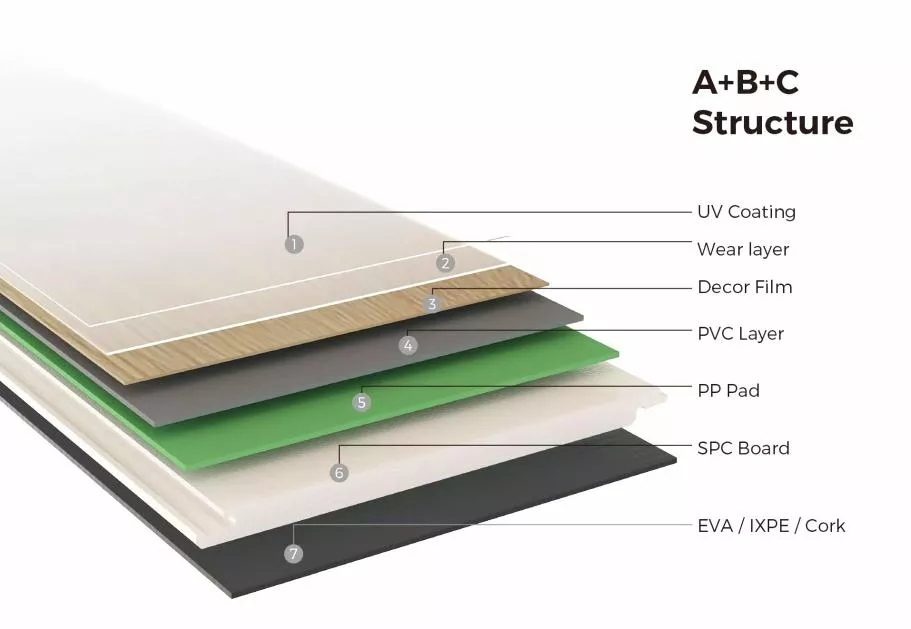
ABA refers to a three-layer structure used in vinyl flooring production. Think of it like a sandwich: two outer layers (A) with a core layer (B) in between. This layered design isn’t random—it’s engineered for balance, durability, and cost efficiency.
The Layered Sandwich Effect
Think of ABA like a club sandwich: the bread on top and bottom gives structure and stability, while the filling in the middle is what actually makes it enjoyable to bite into. In flooring terms, the two rigid "A" layers give the plank dimensional strength and durability, while the "B" layer in the middle — often a dense foam or rubber composite — is doing the heavy lifting on sound absorption. This structure tends to outperform single-layer backings because sound waves have to pass through multiple density changes, and each transition dissipates a bit more energy.
Pros of ABA Floor
· Often the highest sound reduction ratings of the three
· Very stable and resistant to indentation from furniture
· Performs well in both impact and airborne sound categories
· Great for demanding commercial or multi-family projects
Cons of ABA Floor
The catch is cost and thickness. ABA structures tend to be pricier to manufacture, and the added thickness can sometimes create transition height issues where the new floor meets carpet or tile in adjoining rooms.
Installation Tips for Maximum Sound Performance
Whichever option you land on, remember that even the best flooring can underperform if it's installed poorly. A few quick tips: always check subfloor flatness first (dips and bumps can compromise the backing's contact and reduce sound dampening), use recommended underlayment if the manufacturer suggests it even with pre-attached foam, and leave the proper expansion gap around the room's perimeter so the floor isn't rigidly locked against the walls, which can actually transmit vibration through the structure.
FAQs
Is soundproof vinyl flooring waterproof too?
Most soundproof vinyl flooring, including all three structures discussed here, is inherently waterproof since the core material is PVC-based. Always confirm with the specific product spec sheet though.
Can I install soundproof flooring over existing tile?
In many cases yes, especially with Looselay and Lite-Sound, as long as the existing surface is flat, clean, and structurally sound.
Does thicker always mean quieter?
Not necessarily. The structure and material composition (like the foam density in Lite-Sound or the sandwich layering in ABA) often matter more than raw thickness alone.
 English
 العربية
 Français
 Русский
 Español
 Português
 Deutsch
 italiano
 日本語
 한국어
 Nederlands
 Tiếng Việt
 ไทย
 Polski
 Türkçe
 ភាសាខ្មែរ
 Bahasa Melayu
 ဗမာစာ
 Filipino
 Bahasa Indonesia
 magyar
 Română
 Čeština
 қазақ
 Српски
 فارسی
 Kiswahili
 Slovenčina
 Slovenščina
 Norsk
 Svenska
 українська
 Ελληνικά
 Suomi
 Հայերեն
 עברית
 Dansk
 اردو
 Hrvatski
 Afrikaans
 Gaeilge
 Eesti keel
 Oʻzbekcha
 latviešu
 Azərbaycan dili
 Беларуская мова
 Български
 ქართული
 Hausa
 Lietuvių
 isiZulu